
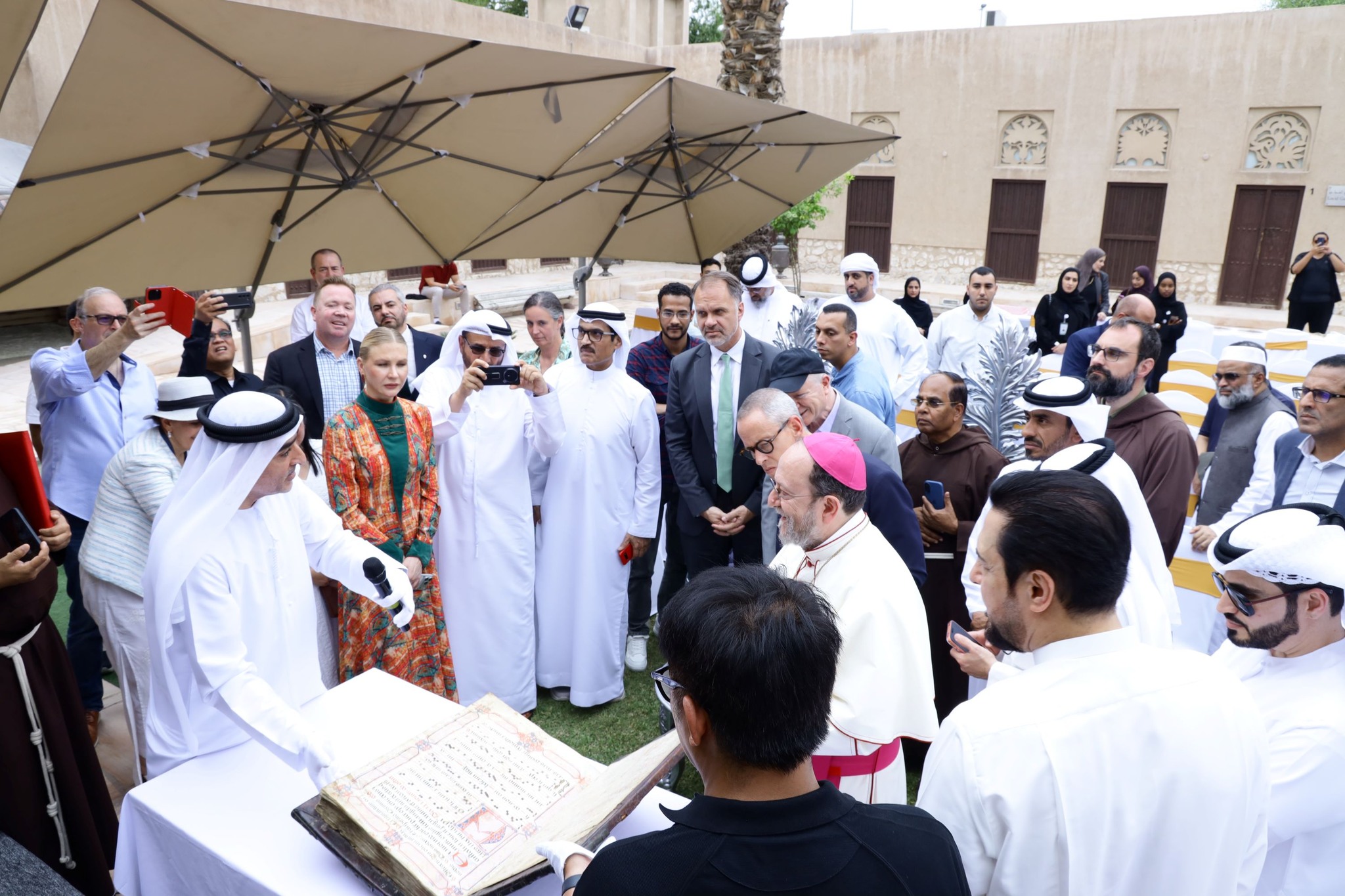
The Cross-Civilizations Museum in Dubai, in collaboration with the Juma Al Majid Center for Culture and Heritage, organized a cultural event held in the Al Shindagha area of Dubai on Tuesday, April 21, focusing on a rare Andalusian manuscript, considered one of the most prominent and rarest complete examples in the world: the Mudéjar Antiphonary, dating back to the 14th century CE.
The event, titled “Living Evidence of the Convergence of Faith, Artistic Beauty, and the Dialogue of Civilizations Across the Ages,” was attended by His Excellency Archbishop Paolo Martinelli, Apostolic Vicar of Southern Arabia and representative of His Holiness the Pope, and Dr. Mohamed Kamel Gad, Director General of the Juma Al Majid Center for Culture and Heritage, along with a number of consuls and officials, including Robert Rains, Consul General of the United States of America in Dubai, Sibylle Pfaff, Consul General of the Federal Republic of Germany, the French Consul, Ahmed Obaid Al Mansouri, founder of the Crossroads of Civilizations Museum, directors of government institutions in the UAE, business leaders, and university students.
Participants emphasized that hosting this manuscript in the UAE reflects its status as a meeting point of civilizations and a global model for coexistence and openness.
This manuscript, known as the “Modjari Antiphonari,” is considered one of the most complete examples of antiphonal chant used in communal ceremonies in medieval Europe. This work reflects a unique convergence between Western Christian art, in terms of liturgical texts and musical structure, and Islamic art, in terms of geometric ornamentation and visual approach, within the framework of what is known as the Mudéjar tradition, which originated in Andalusia as a result of cultural interaction.
Bishop Paolo Martinelli stated that the presence of this manuscript in the UAE “is in harmony with its role as a space that brings together peoples and cultures,” noting that it embodies a cultural convergence that reflects the ability of societies to interact and coexist, and carries within it shared cultural and human dimensions.
He added that such initiatives “strengthen intercultural dialogue, consolidate the values of peace and understanding, and contribute to building a future based on mutual respect and openness.”
For his part, Ahmed Obaid Al Mansouri emphasized that this manuscript “is not merely a historical artifact, but a living testament to a documented historical reality, where civilizations interacted and contributed to the production of knowledge and the progress of societies,” pointing out that “civilizations do not grow in isolation, but rather through encounter and interaction.” He explained that the Museum of Civilizations’ hosting of this event aligns with the UAE’s approach to fostering the values of coexistence and openness, and to strengthening the role of culture as a bridge for communication between peoples.
In the same Dr. Mohammed Kamel Jad, Director General of the Juma Al Majid Center for Culture and Heritage in Dubai, affirmed that this event is consistent with the mission of His Excellency Juma Al Majid, the Center’s founder, which is based on rescuing and preserving manuscripts as a shared human heritage. He recalled His Excellency’s statement that encapsulates this approach: the responsibility to rescue any manuscript or book threatened with damage anywhere in the world, regardless of its language, subject, or author, stemming from his belief that the book represents the memory of human civilization.
He added that the Center translates this vision into practical initiatives by supporting manuscript preservation efforts globally, through providing restoration equipment and technologies to a number of cultural institutions around the world, thus contributing to the preservation of this heritage for future generations. It is worth noting that only a limited number of complete manuscripts of this type remain worldwide today, with the majority housed in specialized libraries and archives in Europe. This makes its presence in the UAE a valuable addition to the global cultural landscape.
The manuscript is a large book used for communal chanting. Its parchment pages, musical notation, and binding reveal its importance in daily life at the time, while its geometric decorations and artistic influences reflect aspects of cultural exchange between societies within a historical context that witnessed the transfer of knowledge and crafts between civilizations and contributed to the development of arts and sciences.


