
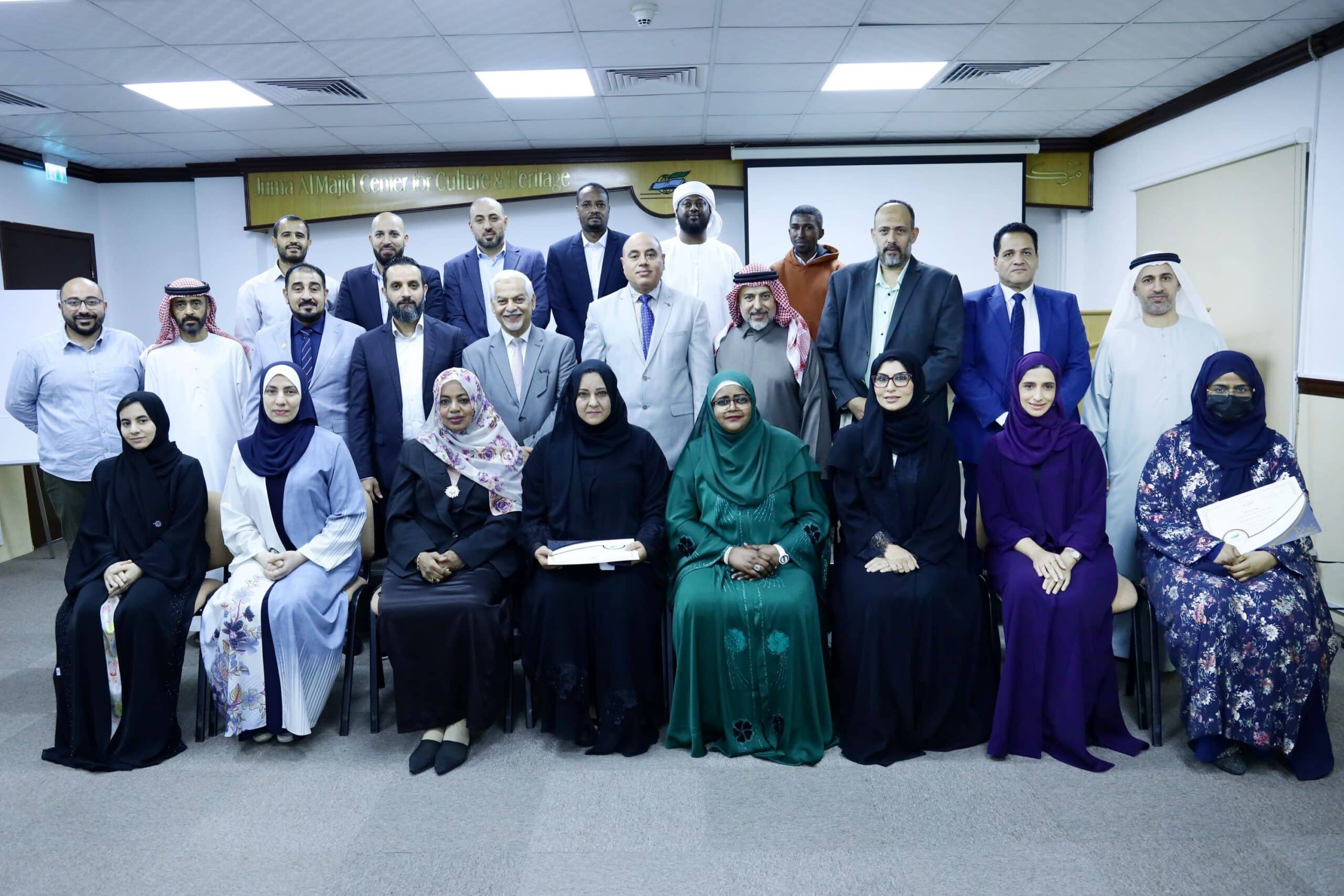
The Juma Al Majid Center for Culture and Heritage concluded its 20th annual course in Library and Information Science on Friday, titled “From Manual Cataloging to Smart Systems: The Future of Technical Processing of Printed and Digital Information Resources”. The program this year included 45 participants from various government and private institutions across the UAE.
Representatives from several entities took part in the course, including state schools under the Ministry of Education, Mohammed bin Zayed University for Humanities, University of Sharjah, United Arab Emirates University, the National Archives and Library, and the Department of Culture and Tourism – Abu Dhabi.
The course was delivered by a team of specialists from the Center under the supervision of Riad Taher Radwan, Head of Technical Processing and Libraries, and spanned five days with active participation from attendees. The program focused on specialized topics such as collection development, acquisitions and exchanges, management of serial publications in public libraries, applications of artificial intelligence and digital transformation, as well as technical processing of both print and digital resources, including cataloging, classification, subject analysis, and performance evaluation in libraries and information centers.
Issam Al-Din, representing the Ministry of Education, delivered a speech on behalf of the participants, expressing gratitude to the Center for organizing this high-level course and highlighting how its content enhanced their knowledge and professional skills, while praising the academic and practical quality of the instructors.
At the conclusion of the program, Dr. Mohammed Kamel Gad, Director General of the Center, addressed the participants, thanking them for their dedication and engagement and conveying the regards of H.E. Juma Al Majid, Chairman of the Center. He emphasized the importance of library and information sciences, particularly cataloging and classification, as essential pillars in organizing knowledge by accurately describing information resources in terms of title, author, subject, and publication details, enabling researchers to access materials efficiently. Certificates were then distributed to all participants.


