
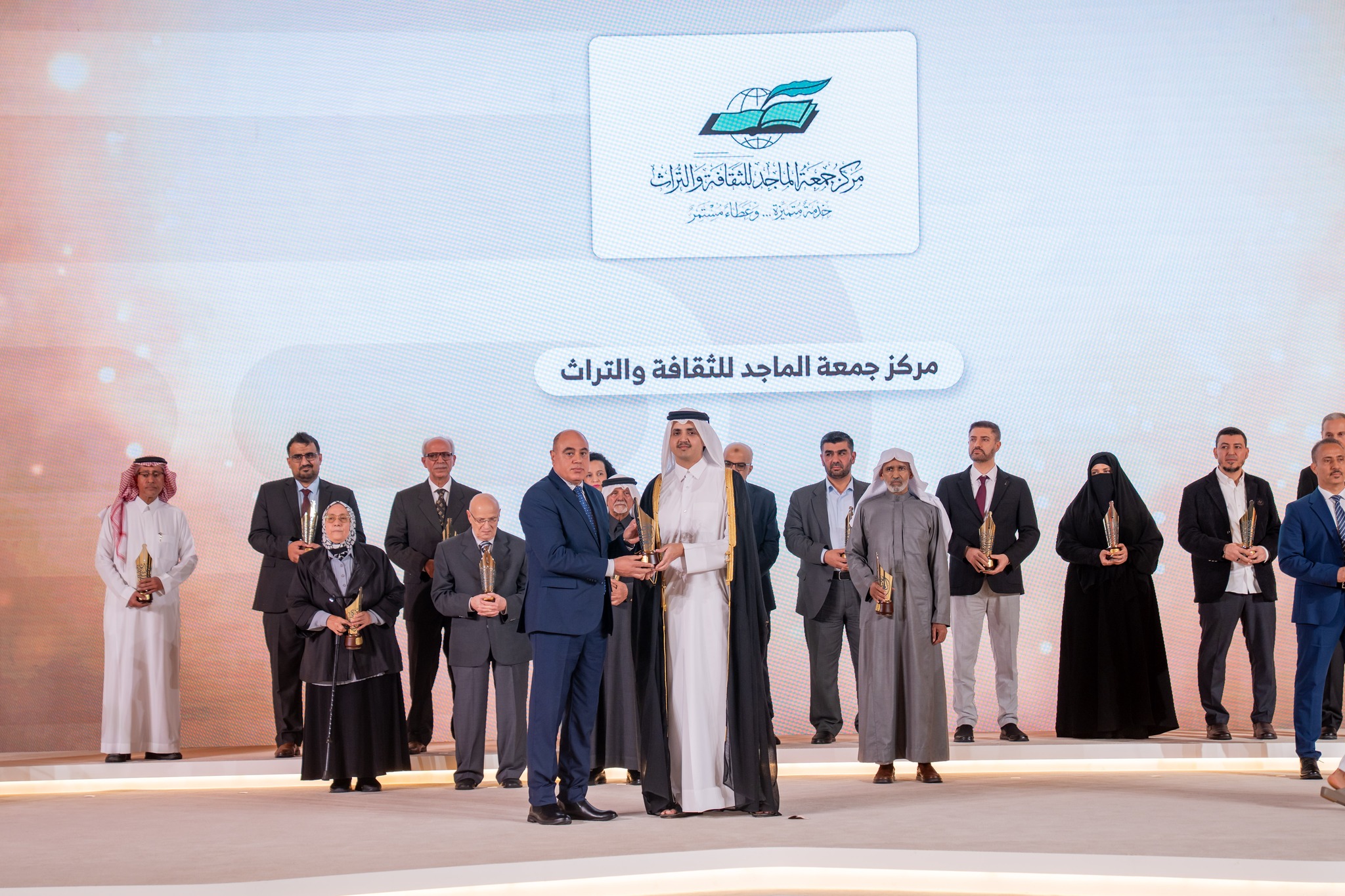
Juma Al Majid Center for Culture and Heritage in Dubai has won the third edition of the Arab Book Award in the Institutional Achievement category, in recognition of its outstanding efforts in serving the Arabic book and preserving the region’s intellectual heritage.
The accolade crowns the Center’s distinguished scholarly and cultural contributions, including the publication of numerous valuable works spanning manuscript heritage, history, literature, and poetry. The award was received by Dr. Mohammed Kamel Gad, Director General of the Center, during the official ceremony held on Tuesday, 27 January 2026, in Doha, where H.E. Sheikh Thani bin Hamad Al Thani, Chairman of the Board of Directors of the Qatar Fund for Development, honored the winning individuals and institutions.
Dr. Mohammed Kamel Gad praised the Arab Book Award, describing it as a prestigious cultural initiative that not only celebrates contemporary creativity but also broadens the scope of recognition to include institutions safeguarding Arab memory and supporting authentic sources of knowledge. He emphasized the Award’s pioneering role in connecting the present with its intellectual roots and in promoting awareness of the Arabic book as a vessel of identity and culture.
Launched by the Qatar in March 2023, the Arab Book Award aims to honor researchers, publishing houses, and institutions contributing to the Arabic publishing industry, encourage authorship in Arabic, and support knowledge production in the humanities, social sciences, and Islamic studies.
On this occasion, Hassan Al Nema, Secretary-General of the Award, stated that the prize serves as a bridge for intellectual and scholarly exchange among thinkers across the Arab world and beyond, illuminating paths of literature, science, and the arts while strengthening the regional and global presence of the Arabic book.
For his part, Dr. Naji Al Sharif, Executive Director of the Award, expressed satisfaction with the outcomes of the third edition, noting that the results were distinguished, particularly as the evaluation process was conducted by a select panel of specialized intellectuals, each within their respective fields.
The third edition witnessed broad participation from more than 41 Arab and non-Arab countries, with over 1,000 nominations submitted. This reflects the Award’s growing stature and its role in supporting the Arabic publishing industry, fostering cultural dialogue, and reinforcing standards of quality and excellence across diverse fields of knowledge beyond traditional frameworks.


